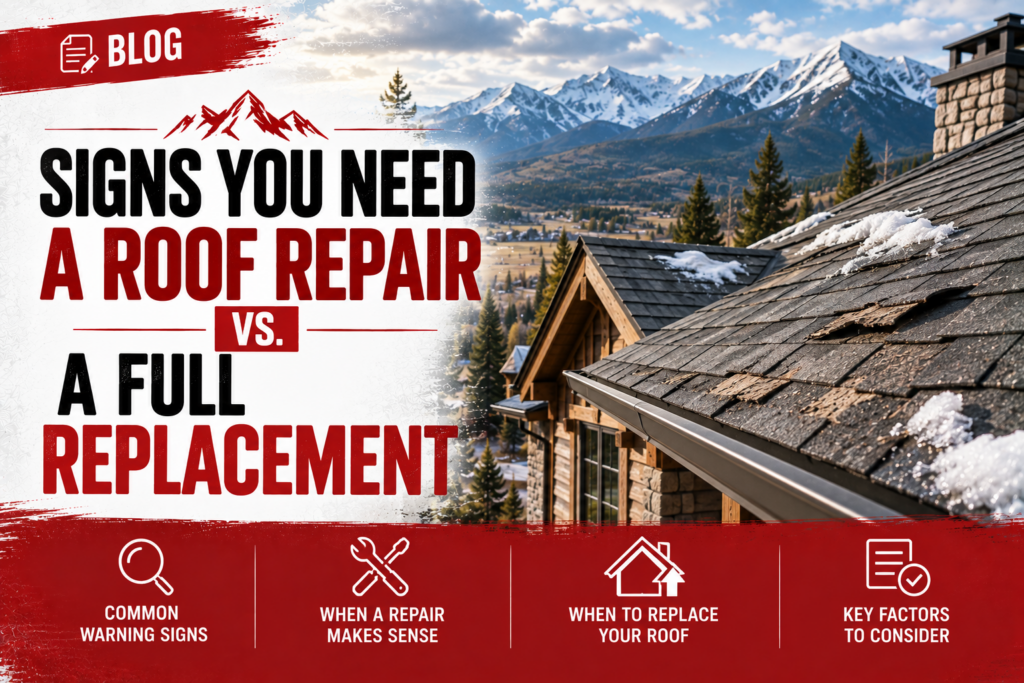
Every homeowner asks the same question when something looks off up top: is this a quick fix, or am I looking at a whole new roof? It’s a fair question, and the honest answer is that it depends on more than just what you can see from the ground. We’ve walked hundreds of roofs across Western Montana, and the decision usually comes down to a handful of specific factors — age, extent of damage, underlying structure, and whether the problem is isolated or systemic. Here’s how to think through it before you call anyone out.
Start With Roof Age
Age is the single biggest factor in this decision, and it’s the one homeowners most often overlook. A standard asphalt shingle roof typically lasts 20 to 25 years in our climate, sometimes less if ventilation or installation quality was poor to begin with. If your roof is under 12 to 15 years old and the damage is localized, repair almost always makes sense. If you’re past the 20-year mark and starting to see problems, a repair might buy you a season, but you’re likely just delaying an inevitable roof replacement — and potentially paying twice for the privilege.
Signs That Point to Repair
- Isolated shingle damage from a fallen branch, a single storm event, or normal wear in one section of the roof
- A leak with a clear, single source — a cracked pipe boot, damaged flashing around a chimney, or a few missing shingles
- Recent, high-quality roof where the rest of the system is clearly in good shape and the issue is contained
- Minor storm damage affecting a limited number of shingles rather than the whole roof plane
- No signs of sagging, widespread granule loss, or deck-level moisture
In these situations, a roof repair is the right call — it’s faster, less expensive, and doesn’t waste the useful life left in materials that are otherwise sound.
Signs That Point to Replacement
- Widespread curling, cupping, or cracked shingles across multiple roof planes rather than one isolated area
- Granule loss visible in gutters or downspouts in significant quantities, indicating the shingles are breaking down at the material level
- Multiple active leaks or staining in more than one room, which usually means the underlayment has failed broadly, not just at one weak point
- Sagging rooflines or soft spots underfoot, which can point to deck damage that a surface-level repair won’t fix
- Roof age past 18 to 20 years combined with any of the above
- Repeated repairs to the same roof over the past few years without resolving the underlying issue
- Storm damage severe enough that an insurance adjuster determines full replacement is more cost-effective than incremental repair
The Cost Question: Why “Cheaper Now” Isn’t Always Cheaper Overall
We understand the instinct to patch rather than replace — a repair is almost always the lower number on the initial estimate. But if your roof is already near the end of its service life, repeated repairs can add up to more than a full replacement would have cost, and you still end up needing the replacement eventually, just on a more stressful timeline (usually after a leak has already caused interior damage). If you want a clear picture of where the numbers land, our roof replacement cost guide breaks down what actually drives pricing so you can compare it honestly against a repair estimate.
What a Proper Inspection Actually Checks
This isn’t a decision you should have to make from the ground, and it’s not one we make from the ground either. A thorough evaluation looks at:
Shingle Condition
We check for granule loss, cracking, curling, and how the shingles are sealing at the edges and in valleys — the areas that fail first.
Flashing and Penetrations
Chimneys, vents, and skylights are common leak points regardless of the rest of the roof’s condition. Damaged flashing can sometimes be the entire problem, even on an older roof.
Decking
Where accessible, we check for soft spots, delamination, or water staining on the underside of the deck, which tells us whether moisture has already gotten past the shingle layer.
Ventilation
Poor attic ventilation accelerates shingle failure from underneath and is a major contributor to the ice dam issues we cover in our guide on cold roof systems. If ventilation is the underlying problem, a repair alone won’t stop it from recurring.
How Ventilation Affects This Decision
One factor that changes the repair-versus-replacement calculus more than most homeowners realize is attic ventilation. A roof that’s failing prematurely — showing significant wear well before its expected lifespan — is often failing because of poor ventilation, not just material age. Heat and moisture trapped in the attic cook shingles from underneath, accelerating granule loss and cracking regardless of the shingle brand or quality installed. If this is the underlying cause, a repair addresses the visible symptom but leaves the root problem in place, which means the same issue will likely resurface in another section of the roof within a year or two. In these cases, we’ll often recommend pairing a repair or replacement with a ventilation upgrade so you’re not solving the same problem twice.
What a Manufacturer Warranty Can Tell You
If your roof is still within its manufacturer warranty period, that’s useful information for this decision. Some warranties cover material defects but not installation-related issues, and understanding which category your damage falls into can affect whether a repair is covered, whether you’re paying out of pocket, or whether a full replacement makes more sense given the remaining warranty value. We can help you review your paperwork and explain what your specific coverage does and doesn’t include.
The Risk of Patchwork Repairs Over Time
A single, well-executed repair on a sound roof is a smart, cost-effective decision. A pattern of repeated small repairs on the same roof over several years is usually a signal worth paying attention to. Each individual repair might seem minor and reasonably priced, but added together, homeowners sometimes spend more on a string of patchwork fixes than a full replacement would have cost — without ever actually solving the underlying issue. If you’ve called a roofer out more than twice for the same general area of your roof, that’s a good moment to ask directly whether replacement is the more sound long-term decision.
Common Questions We Hear
“Can I just repair the section that’s leaking and deal with the rest later?”
Sometimes, yes — if the rest of the roof is genuinely sound. But if the leak is a symptom of broader age-related failure, a targeted repair might mask the problem in one spot while it continues elsewhere.
“Will my insurance cover a repair or does it have to be a full replacement?”
This depends on the cause of damage and your policy. Storm-related damage is often evaluated for full replacement if the adjuster determines the roof can’t be matched or repaired to code. We can walk your specific situation through our FAQ page or talk it through directly with you.
“How do I know if I’m getting an honest recommendation?”
Ask for photos. A contractor who’s recommending replacement should be able to show you exactly what they found and explain why a repair wouldn’t hold up. We document every inspection with photos for this exact reason.
Get a Straight Answer, Not a Sales Pitch
We’d rather tell you honestly that your roof has a few good years left than talk you into a replacement you don’t need yet — and we’d rather tell you now that a repair won’t cut it than have you calling us back after a preventable leak damages your ceiling.
Schedule your free inspection and we’ll give you a clear recommendation based on what we actually find, not what’s easiest to sell. Call AMPCo Construction at (406) 310-1077 with any questions.