Most homeowners in Western Montana think about their roof in terms of shingles — are they cracked, missing, or leaking? But one of the most damaging roofing problems in this part of the state has nothing to do with shingles at all. It happens inside your attic, and most people never see it coming.
Poor roof ventilation quietly shortens the life of your shingles, drives up your heating and cooling bills, causes ice dams every winter, and creates the kind of moisture buildup that rots decking from the inside out. By the time the damage is visible, it’s usually expensive.
Here’s what you need to know about roof ventilation — and how to tell if your home has a problem.
How Roof Ventilation Is Supposed to Work
A properly ventilated roof system moves air continuously through the attic space. Cool outside air enters through intake vents — typically located in the soffits along the eaves — and warm, moist attic air exits through exhaust vents at or near the ridge.
This continuous airflow does two critical things:
In summer, it prevents the attic from becoming a heat trap. Without ventilation, attic temperatures in Western Montana can exceed 150°F on a hot July day. That extreme heat bakes the underside of your shingles and cooks the adhesive strips that bond them — cutting years off their lifespan.
In winter, it keeps the attic cold. This is counterintuitive, but it’s essential. A cold attic means the roof surface stays uniformly cold, so snow melts evenly rather than melting on the upper slopes and refreezing at the cold eaves — which is exactly how ice dams form.
Signs Your Roof Ventilation Is Inadequate
Ice Dams Every Winter
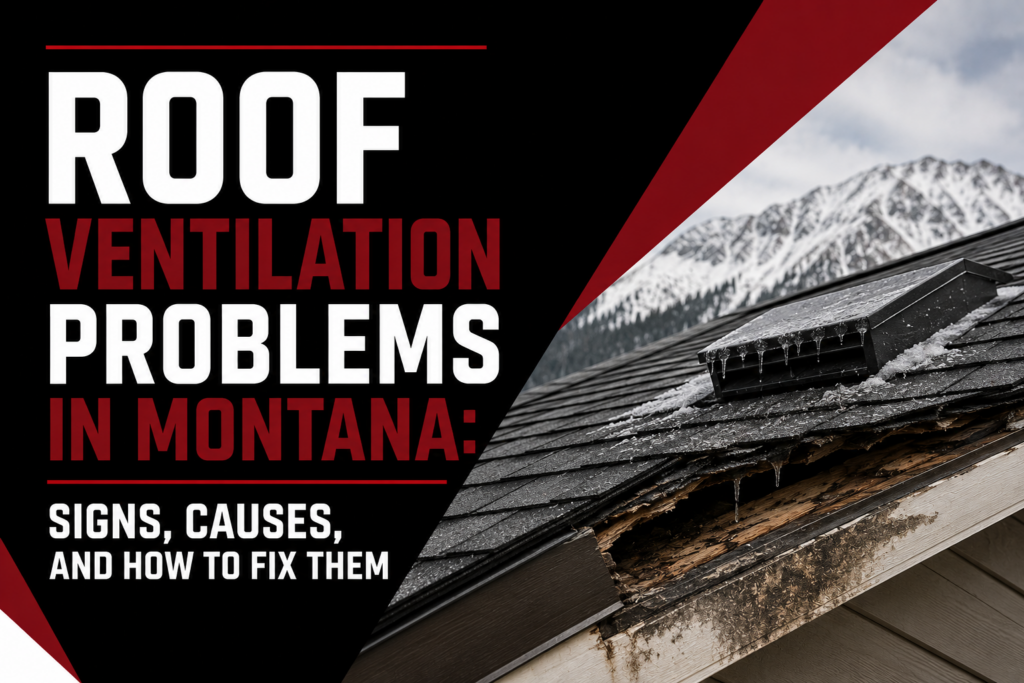
If you’re seeing thick ridges of ice forming along your eaves every winter, poor attic ventilation is almost always a contributing factor. Heat escaping from living spaces into an under-ventilated attic warms the roof deck unevenly. Snow melts up top, runs down to the cold eaves, and freezes. The ice backs water up under your shingles and flashing — and that’s when the leaks start.
Shingles Aging Faster Than Expected
If your roof is only 10–12 years old and already showing significant granule loss, cracking, or curling, excessive attic heat is a likely culprit. Compare your roof’s condition to similar homes in the neighborhood — if yours looks noticeably worse for its age, ventilation deserves a hard look.
High Energy Bills
An attic that traps heat in summer forces your air conditioning to work harder. If your cooling costs seem disproportionate to your home’s size, poor attic ventilation may be part of the explanation.
Moisture and Frost in the Attic
During cold Montana winters, warm moist air from living spaces can infiltrate an under-ventilated attic and condense on the cold decking and rafters. In some cases this shows up as visible frost on attic framing in winter, or as dark staining and mold growth discovered during a roof inspection. Either way, moisture in the attic is a serious problem that compounds over time.
A Hot Second Floor in Summer
If the upstairs rooms in your home are noticeably harder to cool than the rest of the house, the attic above them is likely storing excessive heat that’s radiating down through your ceiling.
Common Ventilation Mistakes in Western Montana Homes
Blocked soffit vents. Insulation installed in the attic floor sometimes covers the soffit vents, cutting off the intake side of the ventilation system entirely. Without intake, exhaust vents can’t pull air through — the whole system stalls.
Too much exhaust, not enough intake. Ventilation balance matters. A roof loaded with exhaust vents but with inadequate soffit intake will actually pull conditioned air from the living space up through light fixtures and electrical penetrations — the opposite of what you want.
Mixing vent types. Installing both ridge vents and high-on-the-wall exhaust vents creates short-circuit pathways where air exits before it properly crosses the attic. This is a common mistake that leaves large portions of the attic unventilated.
No ventilation at all on older homes. Many homes built in Butte and surrounding areas decades ago have little to no designed roof ventilation. What worked marginally with older, less air-sealed homes becomes a real problem when the house is updated with better insulation and tighter windows.
How AMPCo Addresses Ventilation During a Roof Replacement
Every roof replacement AMPCo performs includes a ventilation evaluation. We calculate the net free area required for your attic square footage, check the balance between intake and exhaust, and make recommendations before the new shingles go on.
Getting ventilation right at the time of replacement matters enormously. A premium shingle system installed over a poorly ventilated attic will underperform and age prematurely — and most shingle manufacturer warranties include provisions that void coverage when ventilation is inadequate.
Common ventilation improvements we make during re-roofing:
- Installing continuous ridge vents in place of box vents for more uniform exhaust
- Adding or clearing soffit vents to restore proper intake airflow
- Installing baffles in the attic to maintain an air channel from soffits to ridge when blown-in insulation is present
- Recommending powered attic ventilators in specific situations where passive ventilation alone is insufficient
Get a Ventilation Assessment with Your Free Inspection
If you’ve been dealing with recurring ice dams, a roof that’s aging faster than it should, or moisture issues in your attic, ventilation is worth investigating. AMPCo Construction offers free roof inspections across Western Montana that include an attic ventilation assessment.
We serve Butte, Anaconda, Hamilton, Dillon, Stevensville, Deer Lodge, and surrounding communities. Call us at (406) 310-1077 or schedule your free inspection online.