If you’ve searched for roofing solutions in Montana and come across the term “cold roof system,” you’re looking at a design approach that’s specifically engineered for climates like ours — heavy snow loads, hard freeze-thaw cycling, and the ice dam problems that plague conventional roof assemblies through a Western Montana winter.
AMPCo Construction installs cold roof systems across Western Montana. Here’s a complete explanation of what a cold roof system is, how it differs from a conventional roof, and how to know whether your home or building is a candidate for one.
What Is a Cold Roof System?
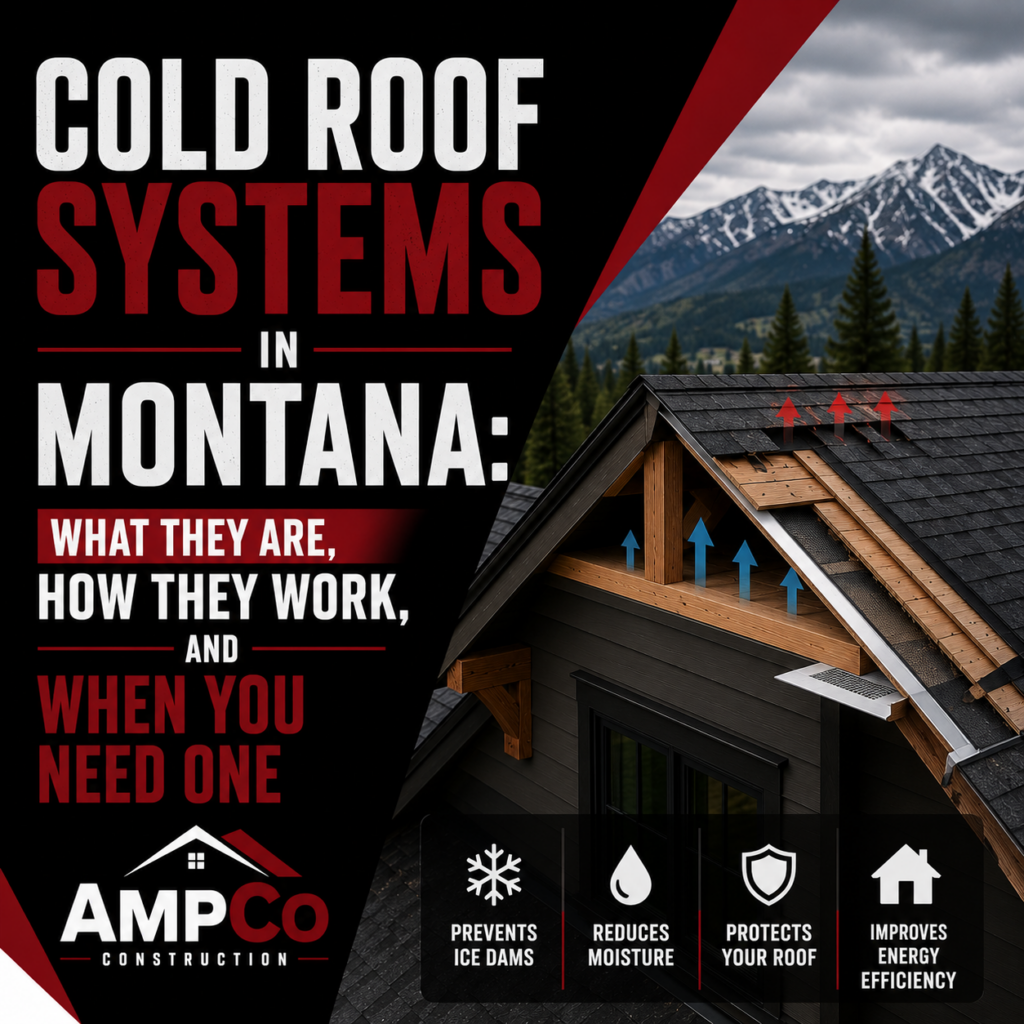
A cold roof system is a roofing assembly that incorporates a deliberately ventilated air gap between the insulation layer and the roof deck. Unlike a conventional “warm roof” where insulation is placed directly against the underside of the roof deck, a cold roof keeps the roof deck cold by allowing outside air to circulate between the insulation and the decking.
The fundamental goal is to make the roof surface temperature match the outdoor air temperature — so that snow on the roof melts and refreezes uniformly, rather than melting over warm sections and refreezing at the cold eaves to form ice dams.
Cold Roof vs. Warm Roof: The Core Difference
Warm Roof Assembly
In a conventional warm roof, insulation sits directly beneath the roof deck. Heat from the living space warms the deck, which warms the roof surface unevenly. Snow melts over the warm sections, water runs down to the cold eaves, and refreezes. Ice dams build up, water backs under shingles and flashing, and leaks follow — often weeks after the original snowfall event.
Cold Roof Assembly
A cold roof separates the insulation from the roof deck with a ventilated air space — typically 2 to 4 inches of clearance with proper intake at the soffits and exhaust at or near the ridge. Outside air circulates through this gap continuously, keeping the deck cold regardless of how much heat the living space generates. Snow stays frozen evenly across the entire roof surface. Ice dams don’t form because the temperature differential that causes them doesn’t exist.
Where Cold Roof Systems Make the Most Sense in Montana
Homes with Chronic Ice Dam Problems
If you’ve dealt with ice dams every winter — water stains on interior ceilings, damaged fascia, gutters pulling away under ice weight — a cold roof system addresses the root cause rather than managing the symptom. Ice dam prevention products like heat cables treat the symptom. Cold roof ventilation eliminates the condition that creates ice dams in the first place.
Metal Buildings and Agricultural Structures
Cold roof systems are standard practice on metal buildings throughout Western Montana — agricultural facilities, equipment storage, commercial structures. Metal roofing conducts heat readily, which makes the temperature differential between the deck and the outdoor air even more pronounced. A ventilated cold roof assembly keeps condensation off the underside of the metal panels and prevents the ice buildup at the eaves that damages gutters and creates hazardous conditions at entries.
New Construction
New construction is the ideal time to incorporate a cold roof design because the ventilation pathway can be built into the framing from the start. Retrofitting a cold roof assembly onto an existing structure is possible but more involved. If you’re building in Western Montana and your site gets significant snow accumulation, discussing cold roof design with your roofing contractor before framing is complete is worth doing.
Homes with Complex Roof Geometry
Roofs with multiple valleys, dormers, and varying slope directions are inherently more prone to ice dam formation because snow accumulates unevenly and melt patterns are irregular. Cold roof ventilation helps normalize the roof surface temperature across complex geometry and reduces the risk of localized ice buildup in valleys and at transitions.
Key Components of a Cold Roof System
- Continuous soffit intake vents — the entry point for outside air into the ventilation gap. Must be properly sized and kept clear of insulation.
- Ventilation baffles (rafter vents) — installed between rafters to maintain the air channel from soffit to ridge, preventing blown-in insulation from blocking the intake path.
- Adequate air gap — typically a minimum of 2 inches between the top of insulation and the underside of the roof deck, with greater depth providing better performance.
- Ridge exhaust — continuous ridge vent or properly calculated exhaust vent area at the peak to allow the ventilated air to exit.
- Air barrier at the ceiling plane — prevents warm, moist interior air from entering the ventilation space and condensing on the cold deck surface.
Cold Roof Systems and Insulation
A common misconception is that cold roof systems reduce insulation effectiveness. Done correctly, they don’t. The insulation remains at the ceiling plane, doing its job of keeping heat in the living space. The ventilation gap is above the insulation, between the insulation and the roof deck — it keeps the deck cold without affecting the thermal performance of the insulation below.
What cold roof design does require is ensuring adequate insulation depth at the ceiling plane, proper air sealing at ceiling penetrations, and a continuous air barrier that prevents conditioned air from bypassing the insulation and entering the ventilation gap.
Talk to AMPCo About Cold Roof Systems
If you’ve been dealing with chronic ice dams, you’re building in a high-snow area of Western Montana, or you have a metal building that needs a cold roof assembly, AMPCo Construction can walk you through the options and what the installation involves for your specific structure.
We offer free inspections that include a ventilation assessment, and free estimates for cold roof installation and retrofit projects. Find out more about our roofing services or call us at (406) 310-1077. We serve Butte, Anaconda, Hamilton, Dillon, Stevensville, Deer Lodge, Missoula, and all of Western Montana.