If you’ve ever looked up at your eaves in January and seen a thick ridge of ice hanging where the gutter should be, you’ve met an ice dam. It’s one of the most common winter roofing problems we see across Butte, Anaconda, and the rest of Western Montana, and it’s almost never bad luck. Ice dams are a symptom of a roof that isn’t built for the way heat and cold actually behave in our climate. The long-term fix isn’t a bigger space heater in the attic or another bag of ice-melt on the roof edge — it’s a properly designed cold roof system.
What Is a Cold Roof System?
A cold roof, sometimes called a vented or double-roof system, is built to keep the entire roof deck at a consistent, cold temperature that matches the outside air. Instead of relying on insulation alone to keep heat inside the house, a cold roof adds an air gap and ventilation path above the insulation layer, so warm air from inside the home never reaches the underside of the roof deck and shingles.
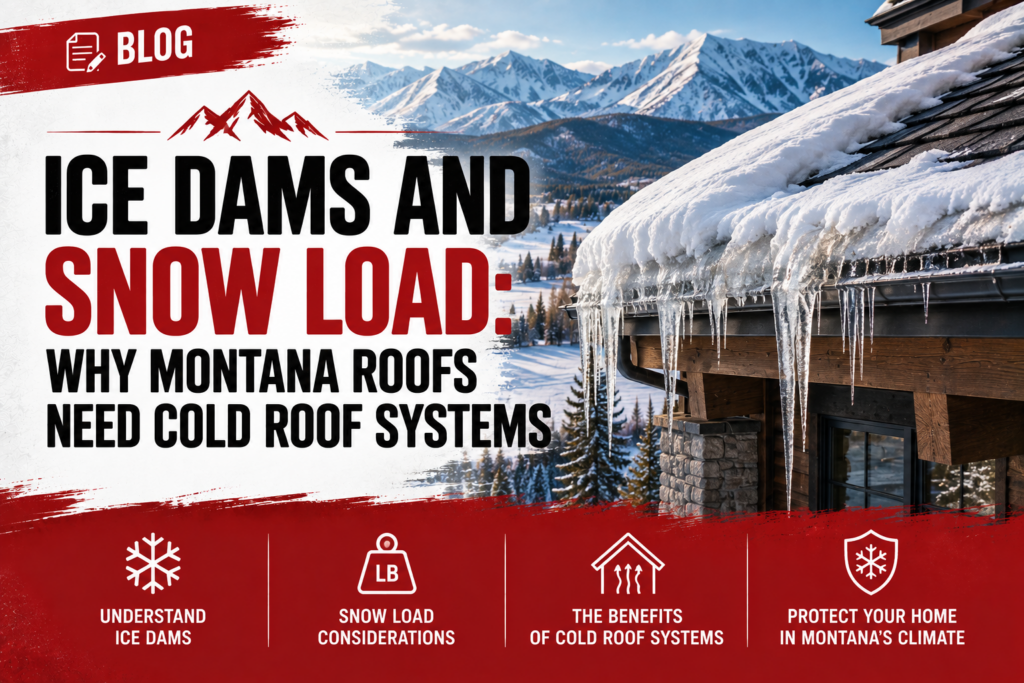
This matters because ice dams don’t form from cold weather alone — they form from an uneven roof temperature. When the upper part of a roof is warmer than the eaves, snow melts higher up, runs down, and refreezes the moment it hits the colder overhang. That refreezing is what builds the ice dam, and it’s also what forces water backward under your shingles, where it has nowhere to go but into your attic, insulation, and eventually your ceiling.
Why Standard Roofing Struggles in Montana Winters
A lot of roofs built to a generic national spec simply weren’t designed with our snow loads and temperature swings in mind. A handful of conditions make Montana particularly tough on a roof:
- Heavy, wet snow accumulation that sits for weeks at a time in higher-elevation areas around Anaconda, Deer Lodge, and the mountain valleys.
- Repeated freeze-thaw cycles where daytime sun warms the roof surface and nighttime temperatures drop well below freezing, over and over through the winter.
- Poor attic ventilation in older homes, which lets heat escape upward into the roof assembly instead of staying where it belongs.
- Inadequate insulation that allows warm, moist air to migrate into the attic space and condense on cold roof sheathing.
Any one of these on its own is manageable. Combined, they’re the exact recipe for ice dams, granule loss from repeated freeze-thaw stress, and in bad cases, structural strain from trapped ice and snow weight.
Signs Your Roof Needs a Cold Roof Retrofit
- Visible icicles or ice ridges along the eaves every winter, not just after unusually heavy storms
- Water stains on interior ceilings near exterior walls that appear in late winter or early spring
- Uneven snow melt on the roof — bare patches near the ridge with heavy accumulation at the eaves
- Curling, cracking, or granule loss concentrated at the lower third of the roof
- A noticeably warm attic in winter, or frost/condensation on the underside of the roof deck
If any of that sounds familiar, it’s worth getting a professional look before another winter goes by. A free roof inspection will tell you whether you’re dealing with a ventilation issue, an insulation gap, aging materials, or some combination of all three.
How a Cold Roof System Actually Solves the Problem
Rather than treating symptoms, a cold roof system addresses the root cause with a few key components working together:
Continuous Air Channel
Furring strips or vented spacers create a gap between the insulation and the roof deck, allowing outside air to flow freely from eave to ridge. This keeps the deck cold no matter how warm the living space below gets.
Balanced Intake and Exhaust Ventilation
Soffit vents pull cold outside air in at the eaves, and ridge or roof vents let it exit at the top. This constant airflow is what prevents heat buildup and moisture accumulation in the first place.
Upgraded Underlayment and Ice-and-Water Protection
Even with a well-designed cold roof, we install ice-and-water shield membrane at eaves, valleys, and penetrations as a second line of defense against the rare event where meltwater does find its way to a vulnerable seam.
Proper Insulation Alignment
The insulation layer is sealed and positioned so warm interior air isn’t leaking upward into the ventilated cavity, which keeps the whole system working as designed instead of getting short-circuited by air leaks around light fixtures, attic hatches, or top plates.
Cold Roof vs. Traditional Insulation-Only Approaches
A common question we get is why more insulation alone doesn’t solve the problem. It’s an intuitive assumption — more insulation should mean less heat escaping, right? In practice, insulation alone only slows heat transfer; it doesn’t eliminate it, and even a well-insulated attic will leak some warmth over the course of a cold Montana winter, especially around recessed lighting, attic hatches, and top plates where insulation coverage is naturally thinner. A cold roof system doesn’t try to stop that heat entirely — it accepts that some warmth will escape and instead gives it a way to vent safely before it ever reaches the underside of the roof deck. That’s the fundamental difference: insulation manages heat loss, ventilation manages where that heat actually goes.
The most effective approach combines both: solid insulation to reduce overall heat loss (and lower your energy bills in the process) paired with a properly vented cold roof assembly to handle whatever heat does make its way up. Neither one alone fully solves the ice dam problem on its own in our climate.
Frequently Asked Questions About Cold Roof Systems
Will a cold roof system work on any home?
Most roof designs can accommodate a cold roof system, though the specific approach varies depending on your existing attic structure, roof pitch, and whether you have a finished or unfinished attic space. Cathedral ceilings and finished attics require a different ventilation strategy than a standard open attic, which is part of why an in-person assessment matters.
How much does a cold roof retrofit typically involve?
Scope varies widely — some homes need a full retrofit with new furring strips and ventilation baffles throughout, while others just need additional soffit or ridge venting to balance an existing system that’s under-ventilated. We’ll only recommend what your specific roof actually needs.
Can I address this the next time I replace my roof, or does it need to happen now?
If your roof still has useful life left and ice dams are a moderate rather than severe problem, ventilation improvements can sometimes be made without a full roof replacement. If you’re within a few years of needing a new roof anyway, it often makes sense to plan the cold roof system as part of that replacement rather than as two separate projects.
Is a Cold Roof Worth It for Your Home?
Not every roof needs a full cold-roof retrofit. Homes at lower elevations with mild winter exposure and adequate existing ventilation may only need targeted improvements — additional soffit venting, an ice-and-water membrane upgrade during a roof repair, or better attic insulation. Homes in colder pockets, at higher elevation, or with a documented history of ice dams typically see the most benefit from a full system.
This is exactly why we don’t push a one-size-fits-all recommendation. During your inspection, we look at your specific roof geometry, attic construction, and ice dam history to tell you honestly whether a full cold roof system, a partial upgrade, or a different fix makes the most sense for your budget and your home.
Where We See This Most
Cold roof retrofits are especially common in our work around Butte-Silver Bow and the Anaconda and Deer Lodge area, where elevation and consistent winter snowpack make ice dam problems more pronounced than in some of the lower valleys we serve.
Stop Fighting Ice Dams Every Winter
If you’ve spent one too many Februarys knocking icicles off your gutters or patching a ceiling stain, it’s time to look at the roof itself rather than the symptom. A properly designed cold roof system is a one-time investment that ends the annual ice dam cycle for good.
Schedule a free inspection and we’ll tell you exactly what your roof needs, or call AMPCo Construction directly at (406) 310-1077.