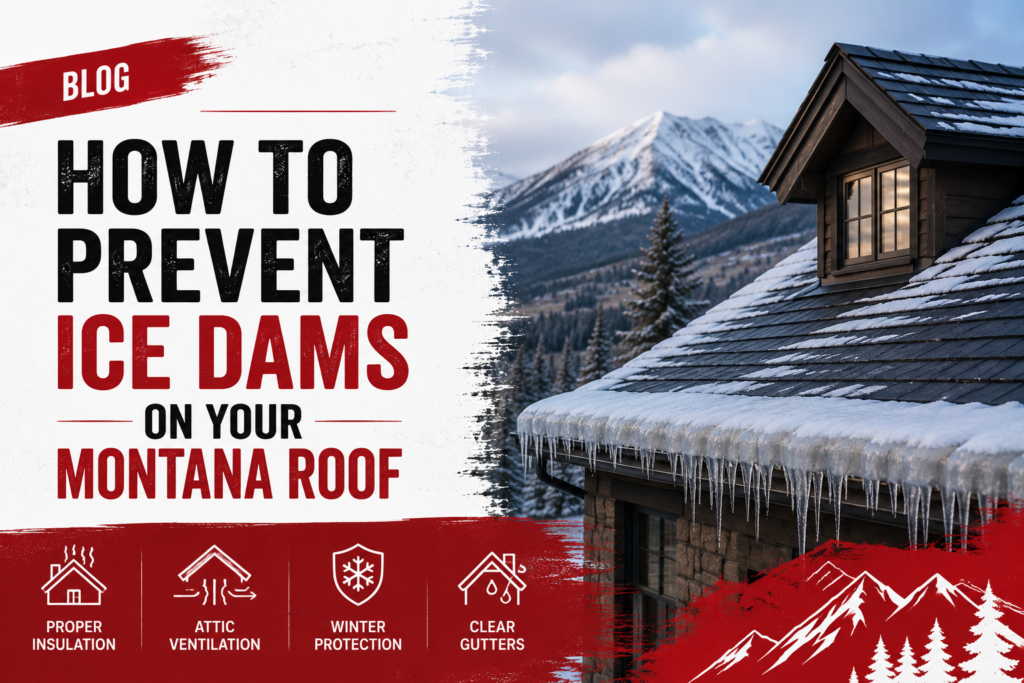
If you’ve owned a home in Western Montana for more than a few winters, you’ve probably dealt with ice dams — or at least seen them. The thick ridges of ice that build up along roof eaves look like a winter novelty until the water they trap starts backing up under your shingles and showing up as a stain on your living room ceiling.
Ice dams cause thousands of dollars in roof and interior damage across Butte, Anaconda, Hamilton, Dillon, and the surrounding region every winter. And they’re almost entirely preventable — not with heat cables or ice rakes, but by addressing the conditions that create them in the first place.
What Causes Ice Dams
Ice dams form because of a temperature differential across your roof surface. Here’s the sequence:
- Heat escapes from the living space into the attic — through inadequate insulation, air leaks at ceiling penetrations, or both.
- The heat warms the roof deck above the living space, causing snow to melt on the upper portion of the roof.
- Meltwater runs down the slope toward the eaves — but the eaves overhang the exterior wall, so they stay cold. The water hits the cold eave section and refreezes.
- Ice builds up along the eave line. As more meltwater runs down and can’t drain past the ice, it backs up under the shingles and flashing, finding any gap to enter the structure.
The result is water intrusion that appears well away from the actual entry point — sometimes in the middle of a ceiling, sometimes along an interior wall, often in places that make the source seem like a mystery.
What Doesn’t Actually Fix Ice Dams
Before getting into what works, it’s worth addressing the approaches that don’t solve the problem — because they’re widely used and widely misunderstood.
Heat Cables
Self-regulating heat cables installed along the eaves melt channels through the ice to allow some drainage. They prevent the worst backup in an existing ice dam, but they do nothing to stop the dam from forming. They consume electricity continuously through the winter, require maintenance, and eventually fail. They’re a band-aid — an expensive one — not a fix.
Ice Raking
Pulling snow off the lower portion of the roof with a roof rake prevents the immediate accumulation that feeds ice dam formation. It works — while you’re doing it, on accessible sections of the roof, after every snowfall. It doesn’t address the heat loss that’s causing the problem, and it’s not practical for most homeowners on most roofs long-term.
Better Shingles or Ice and Water Shield Alone
Ice and water shield is essential at the eaves and in valleys — it’s the last line of defense against ice dam backup. But it doesn’t prevent the dam. A roof with perfect underlayment can still have water back up to a point that exceeds the coverage area of the ice and water shield. The shield is important, but it’s not the solution.
What Actually Prevents Ice Dams
Proper Attic Insulation
The primary goal is to keep heat in the living space where it belongs — not let it escape into the attic and warm the roof deck. Adequate insulation depth at the ceiling plane, combined with air sealing at all penetrations (light fixtures, plumbing chases, attic hatches, and any other gap between conditioned space and the attic), dramatically reduces the heat that reaches the roof deck.
In Montana’s climate, the recommended insulation level for attic floors is R-49 to R-60 for most of the state. Many older homes in Butte, Anaconda, and surrounding communities fall well short of this. If your home has a history of ice dams, an energy audit that assesses attic insulation levels is a logical starting point.
Proper Attic Ventilation
Even with good insulation, some heat enters the attic space. Proper ventilation — continuous intake at the soffits, exhaust at or near the ridge — keeps the attic cold by flushing that heat out before it can warm the deck significantly. A cold attic means a cold roof surface. A cold roof surface means snow doesn’t melt unevenly. No uneven melt means no ice dams.
This is the same principle behind cold roof systems — deliberately keeping the roof deck cold through ventilation design. It’s the most permanent solution available for chronic ice dam problems.
Ice and Water Shield at the Eaves and Valleys
As part of any roof replacement, ice and water shield should extend from the eave edge up the slope at least 24 inches past the interior wall line — and in all valleys. This is the standard AMPCo includes on every replacement. If your current roof doesn’t have it, this is one more reason a full replacement eventually makes sense over repeated repairs.
Frequently Asked Questions About Ice Dams in Montana
Are ice dams covered by homeowner’s insurance?
The interior water damage caused by ice dam backup — ceiling stains, damaged drywall, ruined insulation — is typically covered under most standard Montana homeowner’s policies as sudden and accidental water damage. The roof repair itself may or may not be covered depending on your policy language. Contact your insurer and request a claim review — don’t assume it’s not covered before asking.
My neighbor doesn’t get ice dams. Why do I?
Almost always, it comes down to attic heat loss. Your neighbor’s attic is staying colder — either because of better insulation, better air sealing, better ventilation, or some combination. Two houses built in the same era on the same street can have dramatically different attic conditions depending on how they’ve been maintained and what work has been done over the years.
Will a new roof fix my ice dam problem?
A new roof with proper ice and water shield at the eaves is important, but it doesn’t eliminate ice dams — it just gives you better protection against the water backup they cause. The ice dam itself still forms if the heat loss and ventilation conditions haven’t changed. For a permanent fix, the ventilation and insulation need to be addressed at the same time as the roofing.
How do I know if my attic ventilation is adequate?
The clearest signs of inadequate ventilation are recurring ice dams, a very hot second floor in summer, or frost visible on attic framing during winter inspections. A professional roof and attic inspection gives you the definitive answer. AMPCo includes a ventilation assessment with every free roof inspection.
Get a Free Inspection and Ice Dam Assessment from AMPCo
If you’ve dealt with ice dams in previous winters — or if you’re not sure whether your attic ventilation and insulation are adequate going into another Montana winter — AMPCo Construction can assess the full picture and tell you exactly what needs to change.
Schedule your free inspection online or call us at (406) 310-1077. We serve Butte, Anaconda, Hamilton, Dillon, Stevensville, Deer Lodge, Missoula, and all of Western Montana.