The national average lifespan for an asphalt shingle roof is often cited as 20–30 years. That’s a reasonable range for mild climates. But Western Montana is not a mild climate.
Between the hailstorms that sweep through from May to September, the freeze-thaw cycles that stress shingles from October through April, the UV intensity at elevation, and the occasional 80 mph gusts that come off the mountains — roofs in this part of the state work harder than they do almost anywhere else.
Understanding what actually determines your roof’s lifespan helps you plan better, maintain smarter, and know when it’s time to call AMPCo Construction for a replacement rather than another repair.
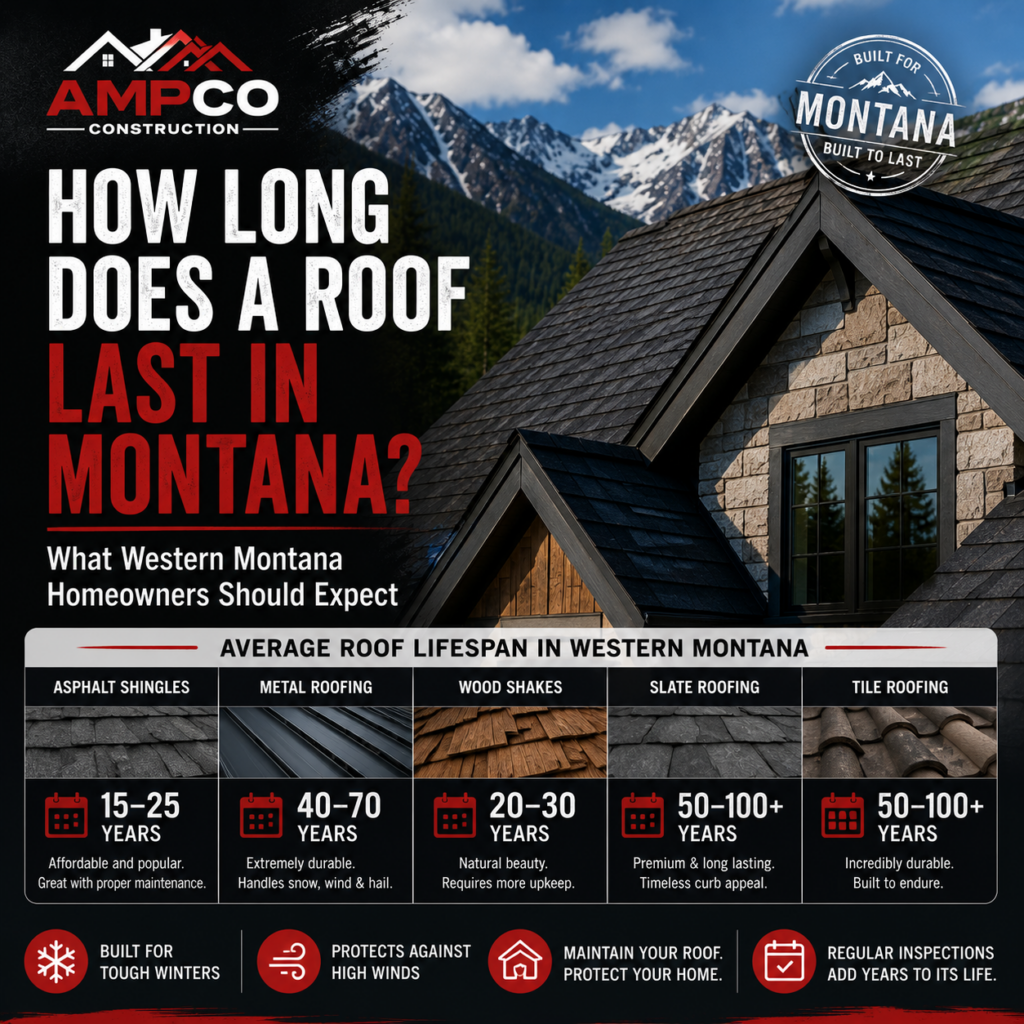
Roof Lifespan by Material in Western Montana
3-Tab Asphalt Shingles
The most economical option and the most common material on older homes in the Butte and Anaconda area. In moderate climates, 3-tab shingles are rated for 20–25 years. In Western Montana’s conditions, expect 15–20 years of real-world performance — less if the roof took a serious hail hit.
Architectural (Dimensional) Asphalt Shingles
The standard today for residential roofing. Architectural shingles have a thicker, laminated construction that resists wind uplift and impact damage better than 3-tab. Rated lifespan is 25–30 years; in Montana, plan for 20–25 years under normal conditions. Higher-grade products carry impact resistance ratings that extend real-world lifespan meaningfully.
Impact-Resistant Shingles (Class 3 or Class 4)
Specifically engineered to withstand hail impact without granule loss or bruising. In hail-prone areas like Silver Bow County, Ravalli County, and the Bitterroot Valley, they’re worth serious consideration. Class 4 IR shingles often qualify for insurance premium discounts — ask your provider. Lifespan in Montana: 25–30 years.
Metal Roofing (Standing Seam or Metal Shingles)
The long-term investment option. Standing seam metal roofing in Western Montana can realistically last 40–70 years with minimal maintenance. Metal handles hail, snow loads, and freeze-thaw cycling better than any asphalt product. The upfront cost is typically 2–3x the cost of architectural shingles, but the lifecycle math often works in its favor.
Wood Shakes and Cedar Shingles
Still found on some older homes in the region. Cedar shakes require more maintenance in Montana’s climate. Realistic lifespan: 15–25 years with regular treatment. Note that many insurance companies in Montana are now adding restrictions or surcharges on wood shake roofs due to wildfire risk.
What Shortens a Roof’s Lifespan in Montana
Hail. A single significant hail event can take years off a roof’s lifespan by stripping granules from the protective surface coating. Granules block UV rays — without them, the underlying asphalt oxidizes and becomes brittle much faster than the rated lifespan suggests.
Ice damming. Ice dams form when heat escapes through the roof deck, melts snow higher on the slope, and that water refreezes at the cold eaves. Over repeated winters, this causes decking rot and premature shingle failure along the lower portion of the roof.
Poor attic ventilation. An improperly ventilated attic traps heat in summer — baking shingles from below and shortening lifespan by 5 years or more. In winter, that same trapped heat drives ice damming. Proper ridge and soffit ventilation is essential, and it’s something AMPCo evaluates on every job.
Low-quality installation. A premium shingle installed with improper nailing patterns, wrong overlap dimensions, or insufficient underlayment will underperform every time. Installation quality matters as much as material quality.
What You Can Do to Maximize Roof Lifespan
- Get a professional inspection every 2–3 years, and always after a significant hail or wind event. Catching small issues early prevents expensive failures.
- Keep gutters clean. Blocked gutters contribute to ice damming and allow water to back up under the drip edge.
- Trim overhanging trees. Branches scraping shingles strip granules and hold moisture against the surface.
- Ensure proper attic ventilation. Ask your contractor to evaluate intake and exhaust ventilation when you replace your roof.
- Don’t ignore flashing. Most roof leaks start at transition points, not the field of shingles.
Frequently Asked Questions About Roof Lifespan in Montana
How do I know if my roof is near end of life?
Look for widespread granule loss — granules accumulating in gutters — along with curling or buckling shingles, multiple areas of cracking, and any signs of water infiltration on interior ceilings. A free professional inspection gives you a definitive answer without any guesswork.
Can I add a second layer of shingles instead of tearing off the old ones?
Montana code allows a second layer in some jurisdictions, and it saves short-term money. However, it adds weight to your structure, prevents inspection of the underlying decking, and the second layer ages faster because heat trapped between layers accelerates deterioration. Most reputable contractors — AMPCo included — recommend a full tear-off for a proper long-term result.
Does a metal roof make sense for a Western Montana home?
For homeowners planning to stay long-term, absolutely. The lifespan and performance advantages are significant, and the hail resistance is excellent. Get a free estimate from AMPCo and we can walk through the cost-benefit comparison for your specific home and budget.
What roofing warranty should I look for?
You want two warranties: the manufacturer’s material warranty (30 years is standard for quality architectural shingles; lifetime for premium products) and the contractor’s workmanship warranty. AMPCo stands behind our installation — ask us about our warranty terms when you call.
Planning for a Roof Replacement in Western Montana?
Whether you’re approaching end of life on an existing roof or you just took a hit from a hailstorm, AMPCo Construction is the roofing contractor Western Montana homeowners call.
We serve Butte, Anaconda, Hamilton, Dillon, Stevensville, Deer Lodge, and the surrounding area. Request a free estimate or schedule a free inspection — or call us directly at (406) 310-1077.