
If you live in Butte, Hamilton, Anaconda, Dillon, or anywhere else in Western Montana, you already know: hailstorms don’t knock politely. They roll through fast, they’re unpredictable, and they can leave behind damage that isn’t always obvious from the ground.
The damage hail does to a roof is often invisible to the untrained eye — until it shows up as a leak six months later, after your insurance window has closed. Here’s exactly what to do in the hours and days after a hailstorm hits your property.
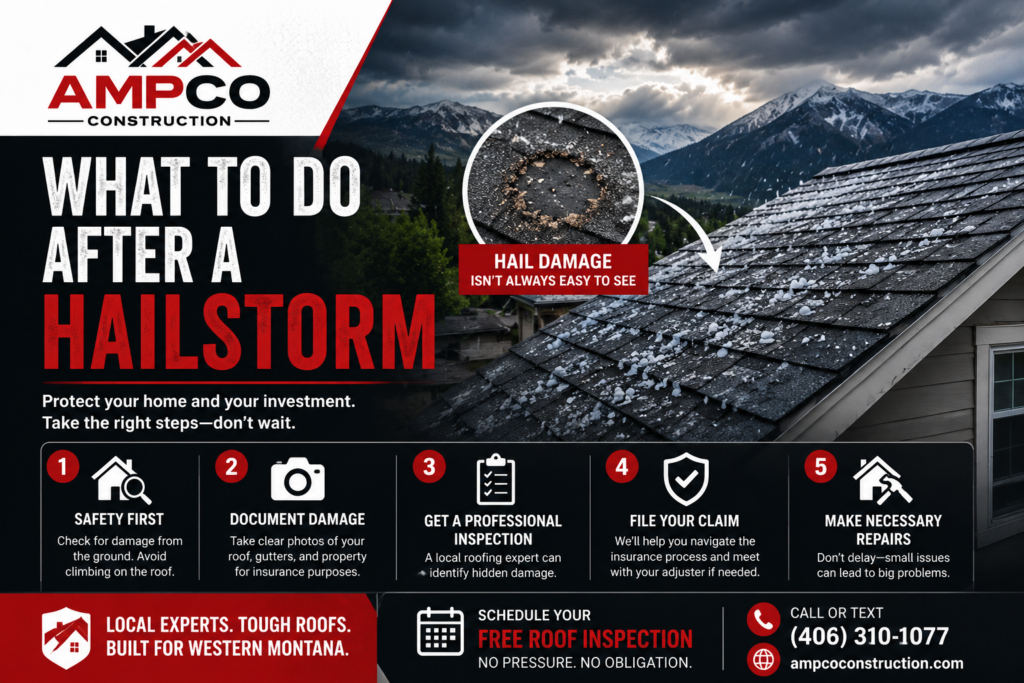
Step 1: Stay Safe — Don’t Get on the Roof Yourself
The first instinct after a storm is to go up and look. We understand it. But wet roofs are dangerous, and if there’s structural damage, you could make it worse. Let a licensed roofing contractor handle the inspection.
What you can safely do from the ground:
- Walk the perimeter of your home and look at gutters, downspouts, and window screens
- Check your vehicles for dings or dents — if cars took hits, the roof likely did too
- Look for shingle material or granules on the ground around the drip edge
- Note the time and size of hail if you observed the storm
All of this information will be useful when you file an insurance claim.
Step 2: Document Everything Before You Touch Anything
Insurance claims live and die on documentation. Before any cleanup or temporary repairs, take photos and video of:
- Dented or cracked gutters and downspouts
- Window screens with impact holes or tears
- Exterior AC units — the fins on HVAC condensers dent visibly from hail
- Any shingles that have blown off or shifted
- Interior ceiling stains if they appeared after the storm
- The ground around your home — granules in the gutters are a key indicator
Take timestamped photos and save them to a cloud folder immediately.
Step 3: Call Your Insurance Company to Open a Claim
If the storm was significant and you saw any of the warning signs above, call your homeowner’s insurance provider to open a claim as soon as possible. Don’t wait.
Most policies have a lookback window for storm damage — typically one to two years from the date of the event. The sooner you file, the stronger your claim. Waiting gives adjusters more reason to attribute damage to wear and tear rather than the storm.
When you call, have ready:
- Your policy number
- The approximate date and time of the storm
- A description of what you observed — hail size, duration, visible damage
- Your photo documentation
Step 4: Schedule a Free Roof Inspection with AMPCo Before the Adjuster Arrives
This step is critical and most homeowners skip it. Insurance adjusters are professionals, but they work for the insurance company. Having your own independent contractor inspection gives you a second opinion — and makes sure nothing gets missed before the adjuster writes their report.
AMPCo Construction offers free post-storm roof inspections across Western Montana. When we inspect your roof after a hailstorm, we document:
- The number of impact hits per square foot on each roof plane
- Granule loss patterns and bruising on shingles
- Flashing damage around chimneys, vents, and valleys
- Gutter and soffit damage
- Any pre-existing conditions separate from storm damage
We can also be present during the adjuster’s inspection to make sure all documented damage is properly noted in their report.
Step 5: Don’t Sign With a Contractor Before Your Claim Is Approved
Storm season brings out storm chasers — out-of-state contractors who flood an area after a major hail event, pressure homeowners into signing contracts immediately, collect the insurance check, and disappear. This is unfortunately common in Montana.
Warning signs of a storm chaser:
- Shows up unsolicited at your door the day after a storm
- Asks you to sign before your claim is processed
- Has no local address, license, or references in Western Montana
- Offers to waive your deductible — this is insurance fraud
AMPCo Construction is locally rooted in Butte, Montana. We’re not going anywhere. We’ll give you time to go through the proper process — and we’ll be here when you’re ready.
Step 6: Get Your Roof Repaired or Replaced Properly
Once your claim is approved and you’ve selected a contractor you trust, the actual work begins. Depending on the scope of damage, you may be looking at:
- Emergency tarping if there are active leaks — AMPCo provides this quickly after severe storms
- Partial replacement of damaged sections if damage is isolated
- Full roof replacement if hail impacted the entire surface and your roof is nearing end of life
AMPCo handles the full scope and works directly with your insurance adjuster to make sure the approved scope matches the actual work needed.
Western Montana Hail: More Common Than Most People Realize
Butte and the surrounding area see hail-producing thunderstorms regularly between May and September. Silver Bow, Ravalli, Beaverhead, and Deer Lodge counties have all seen significant hail events in recent years. If your roof hasn’t been inspected in the last few years, there’s a real chance it has damage you don’t know about.
Don’t Wait — Hail Damage Gets Worse Over Time
Hail bruises the protective granule surface of asphalt shingles. Once granules are gone, UV exposure accelerates aging of the underlying mat. What looks like a small impact today can become a serious leak within 12–24 months.
Request your free inspection from AMPCo Construction or call us at (406) 310-1077. We serve Butte, Hamilton, Anaconda, Dillon, Stevensville, and all of Western Montana.